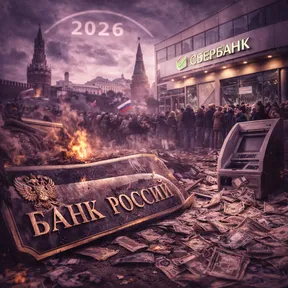
Will Russia enter a full-scale systemic banking crisis in 2026?
According to the Central Bank of Russia, the share of problem loans in the banking system rose sharply over the past year. As of January 1, 2026, problem consumer loans increased to 13% of banks’ portfolios (up from 9% a year earlier), totaling 1.7 trillion rubles, while problem mortgage loans nearly doubled to 1.7% (about 400 billion rubles). Corporate problem loans also increased, reaching 11% of portfolios, or 10.4 trillion rubles by December 2025. These loans are classified as having the highest risk of impairment or prolonged payment arrears. Based on updated asset structure data, the Center for Macroeconomic Analysis and Short-Term Forecasting (CMASF) stated that one formal criterion of a systemic banking crisis has been met, as the share of problem assets exceeded 10% of total banking system assets in 2025. However, both CMASF and the Central Bank emphasize that the crisis remains latent and moderate, citing extensive loan restructuring, high reserve coverage (over 90% for consumer loans), and the stabilizing role of state-owned banks. The key uncertainty is whether these buffers will continue to contain risks or prove insufficient if economic conditions deteriorate further.
Conditions
Resolves “Yes” if by December 31, 2026, Russia experiences a systemic banking crisis marked by at least one of the following, as acknowledged by the Central Bank of Russia or reported by major financial media: forced reorganization or failure of banks accounting for more than 10% of banking system assets; a significant and sustained deposit outflow; or extraordinary state recapitalization of the banking sector exceeding 2% of GDP. Otherwise — “No.”


Comments