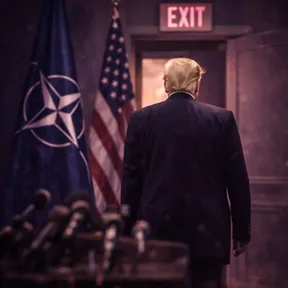
Will United States actually move to exit NATO under Donald Trump?
Trump’s rhetoric marks one of the strongest signals yet of potential disengagement from NATO, driven by frustration over allies’ refusal to support operations related to Iran and the Strait of Hormuz. Public criticism of key partners like the United Kingdom and France suggests growing tension within the alliance. However, an actual withdrawal is far more complex than political statements. NATO membership is deeply embedded in U.S. strategic, military, and legal frameworks, and exiting would face significant institutional resistance both domestically and internationally. It would also carry major geopolitical consequences, including weakening Western security architecture and reshaping global alliances. The most realistic scenario is increased pressure on NATO allies and a possible redefinition of U.S. commitments, rather than a full withdrawal in the near term.
Conditions
Resolves “Yes” if by October 31, 2026, United States: formally initiates or completes an official withdrawal process from NATO (e.g., legal notification or equivalent formal step) Otherwise — “No.”


Comments